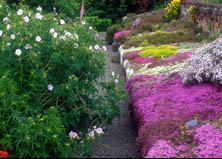
A National Gardens Scheme garden on Windermere
 I've just spent a week in the Lake District, the weather often very wet but the area of the central fells beautiful as always. As well as walking, I couldn't resist going to see a garden, so, seeing that Lakeside Hotel at the bottom end of Windermere was open for the National Gardens Scheme, David and I went there on a wet morning. So often the gardens of hotels are unimaginative and full of routine planting and but this was a revelation! With a managing director who is a very keen gardener and a great gardening team of Martin Thompson and Richard Lucas, the gardens are full of ideas and good plants.
The front lawn which borders Windermere has been excitingly treated as a labyrinth. Once there is enough spring growth on the lawn, it is cut at a variety of heights with the actual design traced out with the mower blades on their lowest setting. These are changed each year and if you go on the hotel's website you can see some of the previous designs. I thought it was a really creative use of what would otherwise be a plain green space.
All around the lakeside terrace the planting is lush and full of scented plants; nicotiana, David Austin roses, philadelphus, lilac, jasmine, heliotrope, lemon balm and many others. The most unusual is a large shrub of Calycanthus occidentalis which has curious, reddish apple scented flowers. 
The tables on the terrace (allowed to go a pleasing natural silver, not horribly stained with preservative as is often seen!) have terracotts pans full of mini-plantings of houseleeks and sedums. Large wooden planters at the front of the hotel are given height with wigwams of fresh willow allowed to sprout leaves and covered in the twisting swags of the gorgeous Rhodochiton atrosanguineus rising out of white dahlias and blue Salvia patens, a lovely combination.
Even the interior courtyard of the hotel is transformed with colourful painting on the walls and tropical feeling banana trees, pawlonia, creepers and eucalypts. It's the kind of area that in many hotels becomes a place for sticking the wheelie bins and trolleys, often a rather depressing back area that some unfortunate bedrooms look out on but not here! It has the atmosphere of a Mediterranean courtyard and the colour of the walls made it feel sunny even on a wet September day. There is much to admire in the hotel's garden (planting of local heritage varieties of apple, scented pelargoniums in the conservatory, a wide variety of trees and shrubs) but the other really dynamic feature is this pretty little parterre. Looking at it with the backdrop of the 'country house' which has bedrooms with individual gardens, it just looks like an attractive assymetric design - until you realise that it is in fact a roof garden over the swimming pool. There is just 15cms of topsoil and a special drainage system and the clipped box beds are full of scented herbs. I hope it might inspire other hotels to realise just what potential there is for creating something really special.