Showing posts with label perennials. Show all posts

Thursday, 18 June 2009

Of peonies and quirky birds nests

Just now the peonies are in bloom, sumptuous bowls of cupped petals with yellow stamen hearts and gorgeous foliage. There are some wonderful rich colours, deep, deep red, crimson, sugar pink, white and salmon and the wilder natured herbaceous plants flow in and around them (pretty Geranium asphodeloides for example, with its tracery of stems and stars of pink and white). The lady's mantle is at its absolute best, frothy green flowers lapping over the gravel of the paths, breaking up the edges to create instant informality. As soon as it starts to go over, I will be cutting it ruthlessly back to prevent self seeding and to bring on new foliage.


Everywhere our abundant wildlife can be seen, blackbirds and thrushes eating the cherries (happily sacrificed to them in return for all the good work they do), blackcaps singing in the walnut, newts lazing in the pond and in the greenhouse a nest of great tits ..... in the cupboard. The birds get so used to visitors that they become very tame - our bird feeder is a great place to get close to nuthatches. And every now and then a bird nests in a quirky place - wrens in an old compost heap, duck on top of one of the walls, pheasant right next to the path. This year it's a great tit that has nested in the old wooden cupboard and flies in through a gap above the door! You can hear the chicks cheeping inside and I darent put up a notice saying 'do not open door because of bird nest' because if I draw attention to it, someone may do just that. They nip in and out when people are not looking, even though there is lots of coming and going in the greenhouse. These are not brilliant pictures but I didn't want to disturb them too much.... I'll give an update when they fledge!

Sunday, 2 November 2008

Cutting back perennials

The walled garden was closed for this season last Friday and will re-open next March which means a bit of time off for us; there will be moments of quiet and contemplation rather like a seaside resort that has been shut up for winter. The weather has been lucky for the last few weeks with mostly dry days and this has really helped in getting the garden 'put to bed'. Perennials in the borders have been cut down, seeds have been saved in paper bags, roses pruned back and all the comfrey harvested for the third time this year for the compost heap. Despite the usual guidance in books to leave four inches on perennial stems to protect the plants in the winter, I cut most plants hard back to the ground so it is easier to rake up leaves; this has never resulted in anything being lost as all the plants I treat this way are completely hardy. What is left untouched is more borderline - the fabulous beds of Verbena bonariensis (see last posting) as well as anything with a particularly lovely winter outline such as sea holly. Teasels are left standing for the goldfinches to feast on.

We had several frosts last week, the hardest being on Wed/Thurs night and it resulted in a magical transformation for a few short hours. These photos show the effects. Especially beautiful was the Heuchera 'Amber Wave' which has been much admired all season, growing in a large terracotta pot by the blue entrance gate. I also really liked the contrast between the cold, northern ice crystals and the hot Indian colours of the pot marigolds - Calendula 'Orange King' which was Gertrude Jekylls's favourite (see posting for 24th August showing how we grew the calendula as a companion plant to the runner beans). I will of course carry on blogging through the cold months as last year so you can see what the garden looks like even when it is closed to visitors. And you can see my photographs of wildlife and landscape on the BBC Autumnwatch Flickr group too.

Sunday, 24 August 2008

Companion planting: growing runner beans with pot marigolds

I can't help it but I have to mention the weather yet again! We've had all August's rainfall in the first two weeks of the month; the lawns are witness to this, growing more lushly and needing quicker cutting than I can ever remember. But despite all that, the garden looks wonderful, dreamy and hazy with golden seedheads on tall grasses, massed beds of Verbena bonariensis and swathes of perennials that are never staked but, being densely planted, have held each other up throughout it all. And there have been no outbreaks of pests or if there have, the natural balance of the garden has been able to compensate - blue tits speedily picking aphids from branches, ladybirds and hover fly larvae doing their bit in flower heads and thrushes pulverising snails on the brickwork!

One of the ways that we encourage this balance is by planting a wide range of different herbs and perennials, mixing plants up and allowing self-seeding or in the case of the vegetable garden, companion planting with pot marigolds. These vibrant double flowers, Calendula officinalis 'Orange King' were favourites of Gertrude Jekyll and I love their cheerful, bright Indian colours. Here you can see them grown in front of the runner beans which we are now harvesting - how delicious freshly picked runner beans are! We are growing a variety called 'Painted Lady' for its pretty bicoloured flowers in red and white, good enough to grow in a front garden.

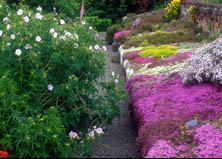
There's so much to notice that is out in flower right now despite the fact that August is a difficult time to keep the garden looking dynamic. One of the hardest working plants I can think of is this low-growing Persicaria affine which spreads in flat mats across the paving slabs and breaks up the line of the gravel path. It's flowers just keep on and on, changing colour as they mature from palest pink, through deep pink to a swathy red. This means that you have all these colours at once on its spreading mass, and its attractive leaves will start to colour up too when the autumn comes. Our gravel paths are made from whinstone from a local quarry just three miles away - whinstone is what forms the rocky outcrops along which Hadrian's Wall loops and twists in much photographed undulations. The grey gravel is such a good foil for so many garden plants and hasn't had lots of miles to travel either!

Monday, 21 January 2008

Winter aconites - the first flowers of the year


My last post was a picture of Chesters Walled Garden under snow. Well, the snow went almost as quickly as it had arrived, followed by a week of weather so dull, wet and miserable that I didn't bother to take any photographs - and now we have a snowfall again! I went out with an umbrella to get a picture of these winter aconites, Eranthis hyemalis, cradled in soft snow, the umbrella necessary to keep the camera dry as it was still bleaching down. A meeting I had was cancelled because the rep couldn't get across country and there is news that the A68 is blocked, again.

Winter aconites are the first perennials to flower in the garden, with the snowdrops and snowflakes not far behind. Although these are already out 'down south', we are always a bit behind. I love the aconites bright green ruff and the particular quality of their yellow flowers. There are some yellows that I really don't like, the colour of Forsythia for one (this is just personal) but aconite yellow has quite a hint of green in it.

A catalogue came in the post today from Cotswold Garden Flowers, Bob Brown's nursery. I have always liked the fact that Bob has strongly held opinions (again entirely personal) and the catalogue gives each plant a score out of ten. He gives a high score to most of the Sanguisorbas, such as S. menziesii (gorgeous), with S. 'Tanna' scoring rather less. Out of my National Collection plants, I agree that it is less exuberant. But I notice he gives an 8 to a Forsythia! Maybe I'll have to check that one out....

Wednesday, 24 October 2007

Beautiful autumn garden, cutting back herbs and perennials


It's been three weeks since my last blog posting because there is so much work to do in the garden at this time of the year. Although many people think of spring as the start of the season, to many professional gardeners, this is the beginning of the yearly cycle; it is now that plans for next year are laid, borders are dug and prepared whilst visualising the spring, plants are moved around and everything is done with the mind's eye on how it will look when the foliage re-emerges. We have been furiously cutting back and sorting out, putting the garden 'to bed' for the winter. Some plants are left standing - eryngiums so that frost can pick out their spiky shapes, teasels for flocks of goldfinches to feast on, Verbena bonariensis to protect it should the winter be hard, peonies until the leaves have turned completely brown and the goodness has gone back down into the tubers.

There are many beautiful moments; the sun slowly breaking through the mist behind the large white daisies of Chrysanthemum uliginosum (picture above), a sudden flurry of long tailed tits tumbling aerobatically through the magnolia, the sharp eyed, sad voiced, robin snatching tiny grubs from by my feet, scintillating drops of water on the drooping, golden heads of Stipa gigantea. The visitors who come at this time of the year tend to be gardeners themselves, without unreal expectations of an autumn garden, people who appreciate the quiet moments and the walled garden's atmosphere. One visitor fell asleep on a sunny bench in the afternoon, another wrote in the visitor's book 'died and gone to heaven'.

Some plants have already been cut back before; geraniums which were sheared after flowering and ladies mantle which was cut right back to its rough, brown crown in summer had put on beautiful, pristine leaves outlined in dewdrops. We now cut these back again so all the foliage can go on the compost heap. Many herbs are vigorously cut back; marjoram (I dont want thousands of marjoram seedlings everywhere!), chives, fennel, valerian, vervain, soapwort, all the herbaceous herbs leaving just the shrubby plants. Some early flowering lavenders were clipped over when their purple tops had faded, late flowering lavender being left til the spring.

We have now had a few nights of frost; the dahlias, runner beans and sweet peas have been hit and leaves are drifting off the trees. I am glad that this accelerates the dying back, so that the underlying structure of the garden is revealed once more, a necessary and welcome part of the cyclical rhythm of the walled garden.

Sunday, 19 August 2007

Colourful AGM chives, marjorams and Joe Pye Weed

Cutting back herbs half way through the season is a great way of having a second (or third) crop of fresh leaves to harvest as well as sometimes producing more flowers. The multicoloured rows in the chive bed were cut down over a month ago and are now looking colourful again. In the picture you can see ordinary chives Allium schoenoprasum at the back, with the rich pink of 'Pink Perfection' and the bright, large heads of 'Black Isle Blush' in the foreground. Both these excellent varieties originated at Poyntsfield on the Black Isle & received an Award of Garden Merit from the RHS. They look so attractive that they can be grown at the front of a flower border or used in combination with low grasses or silvery plants such as lambs ears.

The marjorams are in full flower right now, the plants in the National Collection grown in defined clumps for propagating and identification with a separate area where they are allowed to run riot and self seed in a very natural Mediterranean hillside kind of way.

A plant from a very different kind of terrain, Joe Pye Weed looks rather spectacular in late August and September. Growing wild in damp meadows (on the same sort of land as does our native meadowsweet) this gorgeous tall perennial is way above my head this year, revelling as it has done in the wet summer. Last year, it was a good three feet shorter! Nice to know something has done well out of all the rain. It's a plant that does fine in flower arrangements and lasts ok - I've just given some to one of our volunteers who has the month of August to do the flowers in a local church. Also good for attracting insects, this plant usually has masses of hover flies, bees and butterflies around it but butterflies seem to have been really badly hit by the weather and we've seen alarmingly few - even though the long buddleia hedges are full out. There's lots of late summer flowers out in the walled garden and at least there are plenty of bumble bees.


Thursday, 25 January 2007

winter aconites and snowdrops


Winter aconites are flowering in the garden and have done since the first week in January; I had thought this was rather early but looking at my gardening notes for 1993 I found that they were also out then. Snowdrops are in flower too, but this week of cold weather will hold them back a bit. I am glad of the frosty nights which are a natural part of winter but also glad that I had watched the forecast and thoroughly fleeced the fig and myrtles in the walled garden.
The nuts and seeds are crowded with birds getting food to keep the cold at bay; blue, great and coal tits, robin and dunnock foraging underneath and the splendid vivid colours of greater spotted woodpecker and goldfinch. A bird count is updated each year and is on display in the shop, showing what birds frequent the garden in each month. The teasels are left standing as long as possible for the goldfinches to extract their seeds (the downside is the plethora of teasel seedlings in the borders!) but I cut those down after the last gales had battered them about. The paths are littered with rose hips brought down in the high winds - a beautiful sight, their brilliant orange-red shapes jewelling the grey of the gravel paths. I am keeping a close eye on the tulip beds to make sure the bulbs are not dug up by pheasants again this year. They do so much damage with their large feet and claws, knocking over plants in their pots in the sales area and scratching around. Once we are open and there are visitors in the garden, most of the pheasants move off although there is always one each year that raises a brood of chicks, much to the delight of the visitors!