Showing posts with label wildlife. Show all posts

Thursday, 16 October 2008

The best autumn colour - and a toad with attitude!


Lovely autumn days - what a contrast to the misery of a summer we have had - and there is still so much going on in the garden. The Verbena bonariensis beds are still flowering profusely, visitors are wowed by their sheer size and exuberance and the way that in such a mass they are entirely self-supporting. The sedums are also full out, though sadly we don't have the numbers of butterflies of previous years.I did, though, see this beautiful moth known as angle shades, Phlogophora meticulosa, when we were cutting down the long line of golden yarrow.


There was a lovely full page spread about the garden in The Mail on Sunday just over a week ago and the journalist, Martyn Cox, wrote about all the colour that is still in our garden at this time of the year, and especially mentioned the glorious verbena beds. We are selectively cutting down plants that have finished flowering and this accentuates the colour of the flowers that are blooming - vibrant purple asters, pale jewels of hardy fuschias, rich red rosehips, scintillating grasses, dainty cyclamen, huge cardoons and many others. When cutting back we find lots of toads - I know I posted a picture of a toad recently, but I particularly liked the attitude of this young toad which was hiding under some geraniums!

Tuesday, 23 September 2008

Mellow fruitfullness in a Northumberland walled garden

The grapevine in the greenhouse is loaded with fat bunches of fruit, the grapes hanging all the way along the twisting stems just under the glass. They are best suited to winemaking although they are ok for eating (but have rather a lot of small pips and are a bit tart) - every year I offer them FREE to any winemaker who would like them. They are still up for grabs this year, if anyone would like them!! There are usually enough to fill two or three black bin liners. Pruned last year by my Spanish friend Francisco, (see blog post for 12th November 2007)the vine is looking good and it is a wonderful sight.

When I came into the walled garden this morning, the sun was breaking through a misty start, so emblematic of autumn, and I took this shot of the many layers of planting that you can see across the garden because of the gentle slope. Over the golden flat heads of yarrow and the Scots rose hedge, you can glimpse the huge beds of Verbena bonariensis - looking stunning - and the general fluffiness beyond of wild clematis, Clematis vitalba, with beyond that the trees of the parkland.

It's the start of cutting back time and we have to be so careful when delving into a thick, damp clump of geranium or Shasta daisies because of all the toads. This gorgeous, plump toad is just one of the reasons that the garden is an organic success with its own wonderful balance and equilibrium. There never is a pest that gets out of hand because there is always a predator looking for food. I love the bumpy warts on the toad's skin and it's bright eye! It's such a fulsome, lovely time of year.

Sunday, 24 August 2008

Companion planting: growing runner beans with pot marigolds

I can't help it but I have to mention the weather yet again! We've had all August's rainfall in the first two weeks of the month; the lawns are witness to this, growing more lushly and needing quicker cutting than I can ever remember. But despite all that, the garden looks wonderful, dreamy and hazy with golden seedheads on tall grasses, massed beds of Verbena bonariensis and swathes of perennials that are never staked but, being densely planted, have held each other up throughout it all. And there have been no outbreaks of pests or if there have, the natural balance of the garden has been able to compensate - blue tits speedily picking aphids from branches, ladybirds and hover fly larvae doing their bit in flower heads and thrushes pulverising snails on the brickwork!

One of the ways that we encourage this balance is by planting a wide range of different herbs and perennials, mixing plants up and allowing self-seeding or in the case of the vegetable garden, companion planting with pot marigolds. These vibrant double flowers, Calendula officinalis 'Orange King' were favourites of Gertrude Jekyll and I love their cheerful, bright Indian colours. Here you can see them grown in front of the runner beans which we are now harvesting - how delicious freshly picked runner beans are! We are growing a variety called 'Painted Lady' for its pretty bicoloured flowers in red and white, good enough to grow in a front garden.

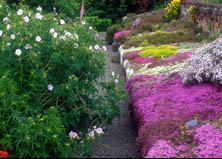
There's so much to notice that is out in flower right now despite the fact that August is a difficult time to keep the garden looking dynamic. One of the hardest working plants I can think of is this low-growing Persicaria affine which spreads in flat mats across the paving slabs and breaks up the line of the gravel path. It's flowers just keep on and on, changing colour as they mature from palest pink, through deep pink to a swathy red. This means that you have all these colours at once on its spreading mass, and its attractive leaves will start to colour up too when the autumn comes. Our gravel paths are made from whinstone from a local quarry just three miles away - whinstone is what forms the rocky outcrops along which Hadrian's Wall loops and twists in much photographed undulations. The grey gravel is such a good foil for so many garden plants and hasn't had lots of miles to travel either!

Saturday, 31 May 2008

"A swarm of bees in June ...."


I've just got back from the garden in late evening where we have been collecting a bee swarm that arrived in a rose bush this afternoon. Of course it just happened to be one of my favourite roses, rich, darkly scented, purple red, and to collect the bees some of the top growth would have to be cut off ... My son, Tom, who is a beekeeper (and has his own website of photographs at www.tomwhitephoto.co.uk) put our old straw skep on top of the rose branches where the swarm was clustering so that the bees would go up into it - they climb upwards naturally and into the dark skep balanced on the branch where the queen was. Left like that til dusk, the bees should all end up in the skep ready to be scooped up - a free prize to a beekeeper.

Using a smoker to encourage the bees to move up the branches, they carefully snipped bits off the rose until the ball of bees was hopefully mostly in the skep and then - this is the difficult bit - tipped the skep into a hessian sack. It's a dramatic moment when the combined buzzing of thousands of bees is heard! You always hope that somewhere in the mass, the queen is there. With the sack tied up (it has to be breathable so hessian is good) the bees were put in the landrover and taken off to a hive that Tom had prepared ready to take them. The old saying of 'a swarm of bees in May is worth a load of hay, a swarm of bees in June is worth a silver spoon, a swarm of bees in July is not worth a fly' means that the earlier a swarm is collected the more valuable it is - well, to get one on May 31st is pretty good!

The other thing that has happened this week has been that is was week 4 of the Poetry Workshop run by poet Linda France. It has been wonderful to see the people on the course quietly taking in the garden in a very deep way - really looking and having the time to reflect (which I envy them as I am always looking for the next job to do!) This is a photograph of the group meeting up at the beginning of the morning.


The workshops are leading up to the event on Midsummer's Day, June 21st, when there will be the world premier of the collaboration between Linda France and world renowned sound recordist, Chris Watson (recently seen on Springwatch). Throughout the day there will be timed presentations of this extraordinary work with live presentations of Linda's beautiful cycle of poems that she wrote from visiting Chesters Walled Garden once a month on the day of the full moon for a calendar year. Chris recorded the sounds of the garden as the birds went to bed and work in the morning (4 am I think it was!). There will also be elderflower champagne, strawberries and music from Northumbrian piper, Sue Dunne. Look out for details on www.queenshall.co.uk.

Thursday, 3 April 2008

Early spring flowers in the walled garden

We have had a lovely couple of days and the wildlife in the garden has responded with exhilaration. Sitting on the bench having our lunch we have watched thrushes, blue tits, great tits, blackbird and chaffinches merrily bathing, splashing and throwing jewelled water drops in the air. We could sense their relief that the days were warm in the way they revelled in the bathing. Ignoring all this completely, a knot of mating toads were croaking away, four males struggling around one poor female. Newts were ambling round about too and all this as we ate our sandwiches!


The tulips are opening - this one is a favourite, 'Scarlet Baby'. There are drifts of scillas and chinodoxas, the delicate yellow cups of Anenome ranunculoides, lovely lungworts, hellebores and the white woodland flowers of Pachyphragma macrophyllum.

At the base of the old magnolia is a pretty spread of my favourite lungwort, Pulmonaria 'Excalibur' which has silver leaves. It lightens the ground under the tree in summer and sets off the plant form sculpture which is by Dennis Kilgallon whose workshop is near us at Kirkharle.


The garden is looking very tidy now and we have had time to go carefully through the Thyme Bank, diligently picking out all the beech leaves, sycamore seeds and winter debris. At the same time, I've been clipping over some of the old flower heads that I missed last year - just last year's flowering tops, no more, as thyme hates being cut into the old wood. Some plants look a bit sad after all the cold, wet weather so I will have to wait and see how they fare, replanting where necessary. I've found a brilliant new tool to clip over the thymes, some one handed shears, rather like sheep shears, but amazingly sharp (and self-sharpening apparently). They are imported from Greece and are particularly useful because you can cut through very soft plant tops where secateurs often snag - the sort of job I might have to go and get a pair of scissors for. I even used them to slice through some frosted succulent leaves of agave! They can be found at www.handshears.co.uk and with their bright red handles, I won't be searching a border to see where I left them!

Monday, 4 February 2008

Reflections in February

After what has been quite a battering from gales and snow, the garden on this early February day, looks calm and poised for growth. Even the suface of the ponds is still, reflecting the sky which has patches of blue. I love this dwarf scots pine which has a very beautiful form, graceful and rounded in shape; in a previous summer gale two years ago, it leant at an angle and I was worried that it would be lost but it seems to have kept the balance of its roots. There are three ponds, one round, one rectangular and a small pool in the greenhouse for the frogs to cool off in summer. Ponds are the single most effective way of enticing a wide variety of wildlife to the garden. The pool by the scots pine has a wooden ramp to help frogs and toads to get out and to save a hedgehog should one fall in.


All the grasses were cut down last week to allow the new growth to emerge (and to tidy it up after the gales!). The grass garden is pretty much at ground level now, a great contrast to its nine feet of height by autumn. The long flower spikes have been cut out of the Stipa gigantea by sliding the secateurs deep down amongst the fine leaves and then we took a rake to them, combing out all the loose dead leaves and debris that collects in the mound of foliage. The effect is always much better and it's really worth doing.

We are propagating lots of plants for sale as the crowns start to shoot away; lungwort, geum, geranium, euphorbia, epilobium, London Pride, sweet violet among others. The wild garlic is looking fresh and green, and the pheasants like to nibble the young shoots. We are splitting wild garlic and potting up it ready for when the garden is open again; made popular by chefs such as Antonio Carluccio, it makes a delicious soup, salad leaf, addition to a potato curry or a casserole and the smell in the woodland when it is full out is quite magical.

Wednesday, 24 October 2007

Beautiful autumn garden, cutting back herbs and perennials


It's been three weeks since my last blog posting because there is so much work to do in the garden at this time of the year. Although many people think of spring as the start of the season, to many professional gardeners, this is the beginning of the yearly cycle; it is now that plans for next year are laid, borders are dug and prepared whilst visualising the spring, plants are moved around and everything is done with the mind's eye on how it will look when the foliage re-emerges. We have been furiously cutting back and sorting out, putting the garden 'to bed' for the winter. Some plants are left standing - eryngiums so that frost can pick out their spiky shapes, teasels for flocks of goldfinches to feast on, Verbena bonariensis to protect it should the winter be hard, peonies until the leaves have turned completely brown and the goodness has gone back down into the tubers.

There are many beautiful moments; the sun slowly breaking through the mist behind the large white daisies of Chrysanthemum uliginosum (picture above), a sudden flurry of long tailed tits tumbling aerobatically through the magnolia, the sharp eyed, sad voiced, robin snatching tiny grubs from by my feet, scintillating drops of water on the drooping, golden heads of Stipa gigantea. The visitors who come at this time of the year tend to be gardeners themselves, without unreal expectations of an autumn garden, people who appreciate the quiet moments and the walled garden's atmosphere. One visitor fell asleep on a sunny bench in the afternoon, another wrote in the visitor's book 'died and gone to heaven'.

Some plants have already been cut back before; geraniums which were sheared after flowering and ladies mantle which was cut right back to its rough, brown crown in summer had put on beautiful, pristine leaves outlined in dewdrops. We now cut these back again so all the foliage can go on the compost heap. Many herbs are vigorously cut back; marjoram (I dont want thousands of marjoram seedlings everywhere!), chives, fennel, valerian, vervain, soapwort, all the herbaceous herbs leaving just the shrubby plants. Some early flowering lavenders were clipped over when their purple tops had faded, late flowering lavender being left til the spring.

We have now had a few nights of frost; the dahlias, runner beans and sweet peas have been hit and leaves are drifting off the trees. I am glad that this accelerates the dying back, so that the underlying structure of the garden is revealed once more, a necessary and welcome part of the cyclical rhythm of the walled garden.

Thursday, 27 September 2007

Newts, toads and dragonflies


There's lots of colour still in Chesters Walled Garden - tall stands of Michaelmas daisies, vivid pokeroot berries, great drifts of Verbena bonariensis and sedums, pretty grass seedheads and sumach turning brilliant red - so there is still work to do in the garden. On wet days, however, we work in the tunnels, cutting back perennials, tidying and top dressing and generally preparing the plants that are for sale for their winter rest. Picking up one of the pots I discovered this drowsy little newt underneath and took its photograph! We often find newts in the tunnels at this time of the year and the fact that no chemicals are used and the watering system comes on every now and then must make it an attractive and safe enviornment for them.

In the garden I found a lovely fat toad, snuggled sleepily down amongst geranium foliage where it had created a low hollow for itself. About the round pond, dragonflies are still restlessly darting, probing the bricks around the edge for places to lay eggs. There are now more butterflies than we have seen all year: red admirals, painted ladies, peacocks, small tortoiseshells. Having had such a poor summer for butterflies, it is a relief to see them in numbers. The robin is singing its thin autumn song and a scruffy blackbird follows me around, getting almost up to my feet in its search for worms and grubs that I disturb while cutting back.

Saturday, 21 July 2007

Pheasant, rain, midge cream and ladies mantle!


Our tame pheasant has now had a second brood and we hope she will be a bit better at mothering this lot; eleven chicks this time that run about crazily all over the lawn, then dash under her sheltering wings. It can be very comical watching them trying to get under her feathers with their legs sticking out. She follows the lawnmower closely, ready for any scattered grass seeds. Up in the air, the young kestrels tumble and cry, then hover over the parkland, whilst on the bird nuts, whole families of blue, great and coal tits are so involved in feeding that you can almost stand next to them.

The rain has done nothing to spoil the garden, in fact the plants are looking really lovely. Deliberately grown close together, all the perennials in the borders are self-supporting and nothing is staked. It all looks very full and natural and beautiful in the evening light if I take a group around. Amazingly, it hasnt rained on a single evening tour this year! Nor have the midges been bad, though we are always have plenty of 'Evening Balm' in the shop which is made in Scotland from organic ingredients.
This is the time for cutting back the first flush of growth; hardy geraniums, some centaureas, oriental poppies, lungworts and especially ladies mantle are cut hard back to create new fresh growth. I sometimes see gardeners have cut the flowered stems from ladies mantle but left the old leaves which I think ends up looking rather tatty. I cut the entire plant back so that all that is left is the brown 'core' and within just a week to ten days it is looking as it does early in the year - a mound of pretty scalloped leaves that hold jewelled water drops.

Tuesday, 26 June 2007

A great week for wildlife!


Last Saturday we held an Organic Day at the walled garden, a day which was supported by Northumberland National Park and had a variety of lovely things going on - bird & bumble bee talks, marquees with garden gifts, music from a Northumbrian piper, tours of the organic vegetable garden, composting demonstrations and a signing of my new book A Sense of Herbs. It was a sunny afternoon and the garden was full of people enjoying the flower borders and peering into them to spot bumble bee species after an inspiring talk from one of the Park rangers. He was able to spot, within a few minutes of coming into the garden, all six common species of bumble bees as well as two species of cuckoo bumble bees (which like the bird take over the nests of other bees)
Things were going on in the pond too as several dragonflies emerged and dried their wings in the sun. This photograph is of a hawker, the largest species of dragonfly that frequents the garden ponds, having spent probably two years in its larval stage in the water. And up til now we have had 67 recorded species of birds but on Saturday morning, with opportune timing, Alan, the birder who compiles our list, saw a female cuckoo flying over which brings the total to 68!

Tuesday, 22 May 2007

Every year a pheasant raises a large brood of chicks in the garden; although this is not particularly popular with the gardeners - dust bathing amongst vegetable seeds is a nuisance! - it is always a hit with the visitors. Many people have been photographing her and her wandering, chirping collection of mottled chicks as they dive in and out of the borders. They are quite comical as they crash land off low stone walls or bump into each other. Yesterday I decided to take my own photographs for my blog so this is her appropriately looking out from amongst the foliage of Aster 'Star of Chesters'.


I next tried to photograph the chicks - not an easy task as they are constantly rushing about! I managed with the one you can see on the right and was taking this, aware that by my elbow was another chick... as I pressed the button I felt a fierce flutter of wings and a sparrowhawk snatched the other chick from right next to me in a precise movement and flew off to the yew tree. She had been so entirely focused on grabbing the chick that the sparrowhawk seemed to have completely ignored me, even though her wings almost brushed my arm. This single mindedness doesn't surprise me as I had a similar experience some years ago when a sparrowhawk took a baby wren from right in front of me.

The Thyme Bank is in flower early this year - almost by a month - and many other plants seem to be flowering before their foliage has achieved its usual height. The garden looks wonderful though and as we are growing more and more late perennials, I don't worry about it running out of steam. Particular delights are the double Ranunculus aconitifolius known as Fair Maids of France, the many alliums and nectaroscordums, the multicoloured rows of chives including 'Pink Perfection' and 'Black Isle Blush', the fresh yellow of perfoliate alexanders and the first flush of hardy geraniums. We have an Organic Day planned for Saturday June 23rd, with free entry to the garden to celebrate organic growing and wildlife - more on this in my next blog...


Monday, 4 December 2006

A windy week in early December

Hearing the high winds in the night, I felt anxious about how the garden was faring - so it was with a little trepidation that I turned the heavy, old-fashioned key in the door to the walled garden. The gales were still battering the tall beech trees around the garden, but there was a calmer atmosphere within the sheltering walls. I walked round to check everything and, apart from some fleece detaching itself and getting snagged in a rose bush, there was no damage to the plants. Having had a mature laburnum tree knocked down last year, I was relieved there were no problems now; over the twenty years I have been running the garden, I have definitely noticed the worsening winds in the last few years, which I personally connect with global warming. The fleece had been protecting a fig tree - another sign that things are changing, as I would not have been able to grow this outside in Northumberland, with or without fleece, in past years.

Mistle thrushes have been making a racket with their throaty, rattling cries as they pick luscious red berries out of the yew trees. It has been a fantastic autumn for fruits of all kinds, the espalier apple trees laden, rose hips making vibrant arching shapes and hazel nuts in the hedgerows providing plenty for the red squirrels. There have always been reds in the woods at Chesters and we sometimes even see them in the garden - one autumn day, a red squirrel curled up on the lawn to sleep in the weakening sunshine. My son, Thomas, is doing the Foundation Degree course in Photography at Newcastle College and wanting to specialise in wildlife photography and this is his photograph, taken this week, of a red squirrel.