Tuesday, 22 May 2007

Every year a pheasant raises a large brood of chicks in the garden; although this is not particularly popular with the gardeners - dust bathing amongst vegetable seeds is a nuisance! - it is always a hit with the visitors. Many people have been photographing her and her wandering, chirping collection of mottled chicks as they dive in and out of the borders. They are quite comical as they crash land off low stone walls or bump into each other. Yesterday I decided to take my own photographs for my blog so this is her appropriately looking out from amongst the foliage of Aster 'Star of Chesters'.


I next tried to photograph the chicks - not an easy task as they are constantly rushing about! I managed with the one you can see on the right and was taking this, aware that by my elbow was another chick... as I pressed the button I felt a fierce flutter of wings and a sparrowhawk snatched the other chick from right next to me in a precise movement and flew off to the yew tree. She had been so entirely focused on grabbing the chick that the sparrowhawk seemed to have completely ignored me, even though her wings almost brushed my arm. This single mindedness doesn't surprise me as I had a similar experience some years ago when a sparrowhawk took a baby wren from right in front of me.

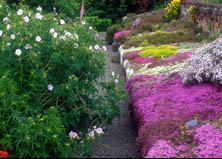
The Thyme Bank is in flower early this year - almost by a month - and many other plants seem to be flowering before their foliage has achieved its usual height. The garden looks wonderful though and as we are growing more and more late perennials, I don't worry about it running out of steam. Particular delights are the double Ranunculus aconitifolius known as Fair Maids of France, the many alliums and nectaroscordums, the multicoloured rows of chives including 'Pink Perfection' and 'Black Isle Blush', the fresh yellow of perfoliate alexanders and the first flush of hardy geraniums. We have an Organic Day planned for Saturday June 23rd, with free entry to the garden to celebrate organic growing and wildlife - more on this in my next blog...


Monday, 7 May 2007

spring herbs

This is such a wonderfully fresh time in the garden with so many herbs looking brightly coloured in their new foliage. Golden varieties such as golden lemon balm and marjoram will lose that intense colour when they start to put on flower spikes, so I value them most at the moment. The lemon balm seen here is growing at the base of one of the old espalier apple trees, its gnarled, tightly pruned spurs starting to put on palest pink flowers. Golden balm makes a pool of brilliant colour at the base of the tree, alongside vibrant yellow Welsh poppies and the equally glowing tops of the perfoliate alexanders, Smyrnium perfoliatum. I first bought this self seeder from the Chelsea Physic Garden years ago and I love its yellow green bracts mixed with the blue flowers on the lower branches of a rosemary bush. Blue and yellow is a perfect spring colour combination.
The tulips have been much admired, not just my favourite red Apeldoorn, but the large drifts of yellow and red striped tulips that were a mistake! I ordered something completely different but visitors have liked them so much that I even had someone mentioning them on the phone from Glasgow. They are planted in the sandy soil of an old greenhouse base where later I hope the newly laid out fox tail lilies will send up their elegant flower spikes amidst the delicate daisies of Erigeron karvinskianus. I say 'hope' because nothing is ever guarenteed in gardening, the weather and the wildlife all playing an unexpected part.
Speaking of wildlife, the thrushes have been feeding newly fledged young all over the garden - I think there are three separate familes and everwhere I go I can hear the tap-tapping of brittle snail shells being pounded against brickwork. The long tailed tits that are nesting deep in a bamboo come out and do aerobatics amongst the tall curving plumes of a pampas grass. I took round a party of 37 from a horticultural society and the long tailed tits put on an excellent performance on cue. Next Sunday, the garden is open for the National Gardens Scheme and the entrance money for the day goes to this excellent charity.

Saturday, 7 April 2007


With the warm weather, the plants are springing away, comma butterflies are on the wing and the garden is busy with birds finding places to nest. I watched a pair of long tailed tits, their beaks holding curving pheasants feathers, disappear into the depths of a bamboo. They have nested here before and I hope they stay again and are not put off by all the garden activity.


Toads have been mating in the Mediterannean Pond, their long necklaces of spawn now twist through the water weeds and frogs are in the little pond in the greenhouse. There are newts in the round pond as well.


The sinister looking plant above is the Japanese Belladonna, Scopolia carniolica. A toxic plant, it contains alkaloids similar to Deadly Nightshade and induces a state of sleep which is similar to normal sleep. It was used at the beginning of the twentieth century in combination with morphine in a preparation known as Twilight Sleep. As a type of anaesthesia it was discontinued as the mortality rate was high!

Wednesday, 14 March 2007


This is such a busy time of year in the walled garden with so much to do getting it ready for visitors and propagating plants for sale. The picture shows part of the wooden, white painted greenhouse, daffodils blooming under the glass and rows of young herbs enjoying this week's sunshine. Original Victorian cast iron grilles make a decorative walkway, the little green leaves of mind-your-own-business growing up between their fretwork. Against the white wall, the pink-flowered nectarine is in bloom, buds are about to burst on the yellow Rosa banksiae and the heavenly rosemary 'Tuscan Blue' is covered in rich blue flowers.

Sitting having a lunch break, we are aware of the great variety of bird song. The old walls, ivy, shrubs and roses provide numerous nest sites and every day there is some little incident that I cherish; today it was having to encourage a robin to leave the tunnel before I lowered the netting, yesterday watching a goldcrest picking its jerky way along the espalier apples just a yard away from me.

I spent the afternoon cutting down the Verbena bonariensis in the two large formal beds. It was a wonderful fuzz of purple in late summer and autumn, much admired by visitors who had not seen it grown en masse before. I am so used to the idea that it might not survive up here in Northumberland, that I leave it until now to prune it back, but after such a mild winter, I wonder if I should actually bother to give it special treatment and cut it down with all the other perennials in the autumn. It does seed itself freely so I will no doubt have lots of seedlings to transplant into the borders if there are any gaps. I keep the large herbaceous borders cram full of ebullience; this helps to keep the soil moist and gives the naturalistic planting for which the garden is known.

Friday, 16 February 2007


The light shining through the Miscanthus in the grass garden looked quite ethereal earlier this week, so it was with mixed feelings that I cut it down to make way for this years growth. This is the time of year when there is much tidying up to do in readiness for visitors coming back to the garden in March. With such a mild winter, some of the herbaceous plants have not died back. Lungworts are flowering already, the hellebores hang their dusky maroon heads and the giant snowdrops, Galanthus plicatus, are the purest white. A ladybird was walking amongst the dead leaves, woken by a warm day on Tuesday.

Each year, Alan Todd, a local birdwatcher carries out a bird count which is displayed in the shop. It shows what birds have been seen in each month and is a fascinating record. This winter he has spotted up to a dozen brambling (or maybe more) feeding amongst the beech leaves and flying over the garden. As they have been uncommon this winter in Northumberland, word got around and a few birders have visited Chesters to tick them off their year list! He was particularly excited to see a Hawfinch (the 1st record at Chesters) sitting in a beech tree near the shop and preening itself for about 20 minutes in the drizzle. This is quite an unusual bird and is described in my bird book as 'extremely wary' so it is not that easy to see despite its huge beak and head. With all the leaf raking (this is the downside of the sheltering woodland), I have been followed around by two robins and a female blackbird, quite the tamest blackbird I have ever known who comes right up to my feet. There's never a day in this garden without something of interest when it comes to wildlfie.

I submitted my new book to the publisher, Ergo Press, along with the drawings I have made of the herbs and work has already begun on the layout. It will hopefully be out in early April if all goes to plan. It was good being able to write it from a personal point of view, drawing on the things I have learnt over the many years of gardening here. The cover looks wonderful with Tom's studio picture of parsley falling into a bowl. It will be out in time for Easter at least; between now and then is lots of hard work in the garden!

Thursday, 25 January 2007

winter aconites and snowdrops


Winter aconites are flowering in the garden and have done since the first week in January; I had thought this was rather early but looking at my gardening notes for 1993 I found that they were also out then. Snowdrops are in flower too, but this week of cold weather will hold them back a bit. I am glad of the frosty nights which are a natural part of winter but also glad that I had watched the forecast and thoroughly fleeced the fig and myrtles in the walled garden.
The nuts and seeds are crowded with birds getting food to keep the cold at bay; blue, great and coal tits, robin and dunnock foraging underneath and the splendid vivid colours of greater spotted woodpecker and goldfinch. A bird count is updated each year and is on display in the shop, showing what birds frequent the garden in each month. The teasels are left standing as long as possible for the goldfinches to extract their seeds (the downside is the plethora of teasel seedlings in the borders!) but I cut those down after the last gales had battered them about. The paths are littered with rose hips brought down in the high winds - a beautiful sight, their brilliant orange-red shapes jewelling the grey of the gravel paths. I am keeping a close eye on the tulip beds to make sure the bulbs are not dug up by pheasants again this year. They do so much damage with their large feet and claws, knocking over plants in their pots in the sales area and scratching around. Once we are open and there are visitors in the garden, most of the pheasants move off although there is always one each year that raises a brood of chicks, much to the delight of the visitors!

Thursday, 4 January 2007

A new year in the garden

After the gales of New Year's Eve (bad enough to force cancellation of Edinburgh's Hogmany fireworks and Newcastle's too), it was with some trepidation that I walked around the walled garden to see if there was any damage. Luckily the only thing was that the fleece that had protected the fig had been torn off and shredded on a nearby rose bush! As a gardener, the one thing I hate above all else is a gale. I cut down the tall teasels, their seeds now eaten by the goldfinches or scattered by the wind and decided that the next job will be to cut down the grass garden to make way for the new shoots. Bulbs are springing up all over the place - snowdrops, Iris reticulata, daffs, snowflakes and the tightly curled fists of winter aconites. The pineapple sage is still flowering exotically in the greenhouse, a jug full of it having been on the kitchen table on Christmas Day. (See blog posting of 11Dec) It's a strange season, with ceanothus and hebes in flower alongside the more expected, scented blooms of Mahonia 'Charity'.

I have started work on a new herb book commissioned by local Ergo press of Hexham. It will be a down to earth guide to growing and eating the most popular herbs and Tom has taken the front cover image. He has just created his own website - www.tomwhitephoto.co.uk - and many of the dazzling images of wildlife and nature were taken in Chesters Walled Garden, from blue tits bathing in the pools to leaves under frost. His blog was mentioned in the letters page of the Independent a few weekends back and that inspired him to go further and make a website too. With the short days, it is good to have time to study seed catalogues, write herb articles and plan for the coming year.