Sunday, 24 August 2008

Companion planting: growing runner beans with pot marigolds

I can't help it but I have to mention the weather yet again! We've had all August's rainfall in the first two weeks of the month; the lawns are witness to this, growing more lushly and needing quicker cutting than I can ever remember. But despite all that, the garden looks wonderful, dreamy and hazy with golden seedheads on tall grasses, massed beds of Verbena bonariensis and swathes of perennials that are never staked but, being densely planted, have held each other up throughout it all. And there have been no outbreaks of pests or if there have, the natural balance of the garden has been able to compensate - blue tits speedily picking aphids from branches, ladybirds and hover fly larvae doing their bit in flower heads and thrushes pulverising snails on the brickwork!

One of the ways that we encourage this balance is by planting a wide range of different herbs and perennials, mixing plants up and allowing self-seeding or in the case of the vegetable garden, companion planting with pot marigolds. These vibrant double flowers, Calendula officinalis 'Orange King' were favourites of Gertrude Jekyll and I love their cheerful, bright Indian colours. Here you can see them grown in front of the runner beans which we are now harvesting - how delicious freshly picked runner beans are! We are growing a variety called 'Painted Lady' for its pretty bicoloured flowers in red and white, good enough to grow in a front garden.

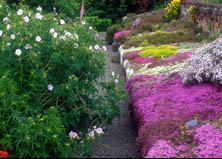
There's so much to notice that is out in flower right now despite the fact that August is a difficult time to keep the garden looking dynamic. One of the hardest working plants I can think of is this low-growing Persicaria affine which spreads in flat mats across the paving slabs and breaks up the line of the gravel path. It's flowers just keep on and on, changing colour as they mature from palest pink, through deep pink to a swathy red. This means that you have all these colours at once on its spreading mass, and its attractive leaves will start to colour up too when the autumn comes. Our gravel paths are made from whinstone from a local quarry just three miles away - whinstone is what forms the rocky outcrops along which Hadrian's Wall loops and twists in much photographed undulations. The grey gravel is such a good foil for so many garden plants and hasn't had lots of miles to travel either!

Wednesday, 13 August 2008

Calendulas amongst the vegetables

What dreadful wet weather we have been having! Yesterday I took a coach party from Floors Castle Garden Club round the garden and it was the first time ever that I had to abandon a guided tour (luckily very near the end) because the rain was coming down so hard! They were, however, cheerful and resilient and vowed to come back when the weather was better. Despite it all, the garden looks lovely.


In amongst the vegetables we grow a particularly good form of pot marigold (Calendula officinalis) called 'Orange King'. This was one of Gertrude Jekyll's favourite flowers and she often incorporated it into her designs - it can be seen for example in the little walled garden at Lindisfarne Castle up the beautiful Northumberland coast, a garden which I included in my book Gardens of Northumberland and the Borders. Calendulas make good companion plant which is why we grow it as well as for the brilliant colour it brings to the vegetable garden. Grown amongst tomatoes, it helps prevent whitefly and lined out with broad beans it's a deterrent to blackfly. Here we've picked the heads without stems and laid them in a blue bowl filled with water with one of the passion flowers from the greenhouse in the centre.


The birds have not being enjoying the wet weather either and I noticed this youngster looking rather bedraggled among the angelica leaves. It's a young stock dove and I love the soft grey colour of its feathers. Alan Todd who carries out a bird count here submits all the records to the British Trust for Ornithology - he has recorded 68 different species including some less common species such as hawfinch. Last week I saw a bird of prey that I think might have been a red kite but I cant be sure til it's confirmed (I didnt have my glasses on!). It's not that unlikely since red kites have been seen just a mile away so we'll have to see if it comes back. If you are a keen birder, come along and see what you can see!

Wednesday, 30 July 2008

Lilies are poisonous to cats


I have some large terracotta pots at home which are planted with sumptuous lilies, all gloriously in flower at the moment and smelling incredibly heady in the late afternoon particularly. Last year we had such heavy downpours that they were spoiled very quickly; this year they are making a wonderful display. I thought I'd post my blog this week about lilies because so many people don't realise that they are very poisonous to cats. This is especially a problem with cut flowers - they might be left on a low table and brushed against by a cat or the flowers chewed. The pollen is so thick - not a good idea to get it on your clothes! and some people cut the stamens off for this reason - and cats may easily groom themselves and injest the pollen. This can cause renal failure, vomiting, blindness, paralysis and death. More details can be found on the Cats Protection website amongst others. I first came across this when I saw a press cutting about it, stuck up with drawing pins in a village noticeboard in Sawrey in the Lake District (near Beatrix Potter's house, Hill Top) by some public spirited cat loving person.

Wednesday, 9 July 2008

Sanguisorba Collection at Chesters Walled Garden


High summer, though you wouldnt know it from the weather, and the Sanguisorba collection is out into flower. Some of the plants will be flowering well into autumn, some, such as salad burnet, are due to be cut back already - so for a long period there are always some plants within the collection in flower. They have had a bit of a battering from the wind and rain and are staked with rusted iron supports which hardly show. I love their flowing forms and mass of small flowerheads waving on long stems. In the foreground is Sanguisorba stipulata (which used to be called S. sitchensis), then Sanguisorba obtusa with its pink candyfloss flowers and behind that a variety of Sagnuisorba officinalis (the wild greater burnet) known as 'Martin's mulberry.'

The garden wildlife is amazing as usual. There is something interesting happening every day, and yesterday it was a young nuthatch that flew into the shop. It kept settling on the wooden beams and I had to turn out the lights to encourage it to fly out of the open door. Also yesterday, I saw the first hawker dragonfly in the garden, newly emerged. This is a bit later than last year (see my blog entry for June 07). Two greater spotted woodpeckers flew onto the nuts whilst some visitors had their backs turned and were choosing plants in the sales area - they were youngsters and less cautious than the adult woodpeckers who will wait until people are rather further away.

I went to photograph a local National Gardens Scheme garden yesterday morning - Cheeseburn Grange at Stamfordham - so that I can write it up for my piece in The Journal. New to the Scheme, it has been transformed from a wilderness over 15 years and I hadnt known what to expect. I was delighted by the garden and felt I could have spent much longer imbibing the atmosphere. For the full description go the Journal archives after next Saturday (icnewcastle.icnetwork.co.uk)

Monday, 23 June 2008

The Moon and Flowers

Saturday was Midsummer's Day but who would have believed it! "Unseasonal" was how the weatherman put it, which was sad because so many people were looking forward to our special event in the garden. Nevertheless, lots of hardy folk turned up, even in the afternoon when it was steadily raining, and had picnics in the yurt in a resiliently British way.

It was the world premier of The Moon and Flowers, a collaboration between poet Linda France and sound recordist Chris Watson, which started as a seed of an idea when Linda visited the garden once a month on the day of the full moon for a complete year. The resulting cycle of poems reflect the seasonal changes in
the garden and much else besides - I can't do them justice by describing them, you need to come to the garden and here them relayed in the clematis-covered arbour where they can be heard for the next couple of months or buy the limited edition copy in the shop.

Chris Watson, world renowned sound recordist who has worked on numerous wildlife programmes, visited the garden with Linda during September's full moon, once at dawn and again at dusk the same day and recorded his soundscape of birdsong and natural noises. Linda said "It was magical. Chris has worked all over the world but, here, we were both almost awestruck. Being in this beautiful place seemed such a privilege." Last Saturday, Linda gave two live readings of the poems, followed by which was Chris's recording of her voice overlaying the birdsong.

The garden was serenely green and lovely in the rain and the readings took place in a beautiful yurt hand-made by Oran Villiers-Stuart (www.underwoodworkshop.co.uk) using local timber, larch, oak and ash. It was the perfect place to hear the poems and to listen to the evocative sound of a Northumbrian piper and, later, a cellist. The whole event was funded by our local arts centre, Queen's Hall in Hexham, and brilliantly brought together by Holly Clay. People came out from Newcastle for the day and we were amazed by just how many ignored the weather and came for what for me was the high point of the year.

Sunday, 15 June 2008

Really sharp hand shears!


At this time of the year there are so many jobs to do in the garden and I have discovered a really useful pair of single-handed hand shears that leave your left hand free to grab grass, long trails of clematis or whatever it is you are trying to cut back. They are also great for harvesting herbs such as this marjoram in the picture. Called Jakoti shears, they are imported by a family in Somerset, who were given a pair by a friend who bought them from a hardware shop on a Greek island. They found them to be so useful for all sorts of gardening jobs from topiary to lawn edging, that they bought them in to sell in Britain.

I like their bright red handles which are cheerful and not easily lost in some box hedge in the garden! They are also, very usefully, self-sharpening and we have now used them for some time in the walled garden and they are still as sharp as when we got them. They are also used for sheep shearing and you can see them in action on the website - www.handshears.co.uk - with a Greek farmer shearing his sheep in a video. It's a strangely lovely video to watch with the only sounds being the tinkling of sheep bells, the snip-snip of the shears and the occasional baa!

Saturday, 31 May 2008

"A swarm of bees in June ...."


I've just got back from the garden in late evening where we have been collecting a bee swarm that arrived in a rose bush this afternoon. Of course it just happened to be one of my favourite roses, rich, darkly scented, purple red, and to collect the bees some of the top growth would have to be cut off ... My son, Tom, who is a beekeeper (and has his own website of photographs at www.tomwhitephoto.co.uk) put our old straw skep on top of the rose branches where the swarm was clustering so that the bees would go up into it - they climb upwards naturally and into the dark skep balanced on the branch where the queen was. Left like that til dusk, the bees should all end up in the skep ready to be scooped up - a free prize to a beekeeper.

Using a smoker to encourage the bees to move up the branches, they carefully snipped bits off the rose until the ball of bees was hopefully mostly in the skep and then - this is the difficult bit - tipped the skep into a hessian sack. It's a dramatic moment when the combined buzzing of thousands of bees is heard! You always hope that somewhere in the mass, the queen is there. With the sack tied up (it has to be breathable so hessian is good) the bees were put in the landrover and taken off to a hive that Tom had prepared ready to take them. The old saying of 'a swarm of bees in May is worth a load of hay, a swarm of bees in June is worth a silver spoon, a swarm of bees in July is not worth a fly' means that the earlier a swarm is collected the more valuable it is - well, to get one on May 31st is pretty good!

The other thing that has happened this week has been that is was week 4 of the Poetry Workshop run by poet Linda France. It has been wonderful to see the people on the course quietly taking in the garden in a very deep way - really looking and having the time to reflect (which I envy them as I am always looking for the next job to do!) This is a photograph of the group meeting up at the beginning of the morning.


The workshops are leading up to the event on Midsummer's Day, June 21st, when there will be the world premier of the collaboration between Linda France and world renowned sound recordist, Chris Watson (recently seen on Springwatch). Throughout the day there will be timed presentations of this extraordinary work with live presentations of Linda's beautiful cycle of poems that she wrote from visiting Chesters Walled Garden once a month on the day of the full moon for a calendar year. Chris recorded the sounds of the garden as the birds went to bed and work in the morning (4 am I think it was!). There will also be elderflower champagne, strawberries and music from Northumbrian piper, Sue Dunne. Look out for details on www.queenshall.co.uk.