Thursday, 16 October 2008

The best autumn colour - and a toad with attitude!


Lovely autumn days - what a contrast to the misery of a summer we have had - and there is still so much going on in the garden. The Verbena bonariensis beds are still flowering profusely, visitors are wowed by their sheer size and exuberance and the way that in such a mass they are entirely self-supporting. The sedums are also full out, though sadly we don't have the numbers of butterflies of previous years.I did, though, see this beautiful moth known as angle shades, Phlogophora meticulosa, when we were cutting down the long line of golden yarrow.


There was a lovely full page spread about the garden in The Mail on Sunday just over a week ago and the journalist, Martyn Cox, wrote about all the colour that is still in our garden at this time of the year, and especially mentioned the glorious verbena beds. We are selectively cutting down plants that have finished flowering and this accentuates the colour of the flowers that are blooming - vibrant purple asters, pale jewels of hardy fuschias, rich red rosehips, scintillating grasses, dainty cyclamen, huge cardoons and many others. When cutting back we find lots of toads - I know I posted a picture of a toad recently, but I particularly liked the attitude of this young toad which was hiding under some geraniums!

Tuesday, 23 September 2008

Mellow fruitfullness in a Northumberland walled garden

The grapevine in the greenhouse is loaded with fat bunches of fruit, the grapes hanging all the way along the twisting stems just under the glass. They are best suited to winemaking although they are ok for eating (but have rather a lot of small pips and are a bit tart) - every year I offer them FREE to any winemaker who would like them. They are still up for grabs this year, if anyone would like them!! There are usually enough to fill two or three black bin liners. Pruned last year by my Spanish friend Francisco, (see blog post for 12th November 2007)the vine is looking good and it is a wonderful sight.

When I came into the walled garden this morning, the sun was breaking through a misty start, so emblematic of autumn, and I took this shot of the many layers of planting that you can see across the garden because of the gentle slope. Over the golden flat heads of yarrow and the Scots rose hedge, you can glimpse the huge beds of Verbena bonariensis - looking stunning - and the general fluffiness beyond of wild clematis, Clematis vitalba, with beyond that the trees of the parkland.

It's the start of cutting back time and we have to be so careful when delving into a thick, damp clump of geranium or Shasta daisies because of all the toads. This gorgeous, plump toad is just one of the reasons that the garden is an organic success with its own wonderful balance and equilibrium. There never is a pest that gets out of hand because there is always a predator looking for food. I love the bumpy warts on the toad's skin and it's bright eye! It's such a fulsome, lovely time of year.

Saturday, 6 September 2008

A National Gardens Scheme garden on Windermere

I've just spent a week in the Lake District, the weather often very wet but the area of the central fells beautiful as always. As well as walking, I couldn't resist going to see a garden, so, seeing that Lakeside Hotel at the bottom end of Windermere was open for the National Gardens Scheme, David and I went there on a wet morning. So often the gardens of hotels are unimaginative and full of routine planting and but this was a revelation! With a managing director who is a very keen gardener and a great gardening team of Martin Thompson and Richard Lucas, the gardens are full of ideas and good plants.

The front lawn which borders Windermere has been excitingly treated as a labyrinth. Once there is enough spring growth on the lawn, it is cut at a variety of heights with the actual design traced out with the mower blades on their lowest setting. These are changed each year and if you go on the hotel's website you can see some of the previous designs. I thought it was a really creative use of what would otherwise be a plain green space.

All around the lakeside terrace the planting is lush and full of scented plants; nicotiana, David Austin roses, philadelphus, lilac, jasmine, heliotrope, lemon balm and many others. The most unusual is a large shrub of Calycanthus occidentalis which has curious, reddish apple scented flowers.
The tables on the terrace (allowed to go a pleasing natural silver, not horribly stained with preservative as is often seen!) have terracotts pans full of mini-plantings of houseleeks and sedums. Large wooden planters at the front of the hotel are given height with wigwams of fresh willow allowed to sprout leaves and covered in the twisting swags of the gorgeous Rhodochiton atrosanguineus rising out of white dahlias and blue Salvia patens, a lovely combination.
Even the interior courtyard of the hotel is transformed with colourful painting on the walls and tropical feeling banana trees, pawlonia, creepers and eucalypts. It's the kind of area that in many hotels becomes a place for sticking the wheelie bins and trolleys, often a rather depressing back area that some unfortunate bedrooms look out on but not here! It has the atmosphere of a Mediterranean courtyard and the colour of the walls made it feel sunny even on a wet September day.

There is much to admire in the hotel's garden (planting of local heritage varieties of apple, scented pelargoniums in the conservatory, a wide variety of trees and shrubs) but the other really dynamic feature is this pretty little parterre. Looking at it with the backdrop of the 'country house' which has bedrooms with individual gardens, it just looks like an attractive assymetric design - until you realise that it is in fact a roof garden over the swimming pool. There is just 15cms of topsoil and a special drainage system and the clipped box beds are full of scented herbs. I hope it might inspire other hotels to realise just what potential there is for creating something really special.

Sunday, 24 August 2008

Companion planting: growing runner beans with pot marigolds

I can't help it but I have to mention the weather yet again! We've had all August's rainfall in the first two weeks of the month; the lawns are witness to this, growing more lushly and needing quicker cutting than I can ever remember. But despite all that, the garden looks wonderful, dreamy and hazy with golden seedheads on tall grasses, massed beds of Verbena bonariensis and swathes of perennials that are never staked but, being densely planted, have held each other up throughout it all. And there have been no outbreaks of pests or if there have, the natural balance of the garden has been able to compensate - blue tits speedily picking aphids from branches, ladybirds and hover fly larvae doing their bit in flower heads and thrushes pulverising snails on the brickwork!

One of the ways that we encourage this balance is by planting a wide range of different herbs and perennials, mixing plants up and allowing self-seeding or in the case of the vegetable garden, companion planting with pot marigolds. These vibrant double flowers, Calendula officinalis 'Orange King' were favourites of Gertrude Jekyll and I love their cheerful, bright Indian colours. Here you can see them grown in front of the runner beans which we are now harvesting - how delicious freshly picked runner beans are! We are growing a variety called 'Painted Lady' for its pretty bicoloured flowers in red and white, good enough to grow in a front garden.

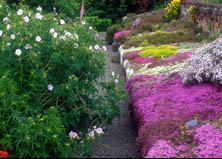
There's so much to notice that is out in flower right now despite the fact that August is a difficult time to keep the garden looking dynamic. One of the hardest working plants I can think of is this low-growing Persicaria affine which spreads in flat mats across the paving slabs and breaks up the line of the gravel path. It's flowers just keep on and on, changing colour as they mature from palest pink, through deep pink to a swathy red. This means that you have all these colours at once on its spreading mass, and its attractive leaves will start to colour up too when the autumn comes. Our gravel paths are made from whinstone from a local quarry just three miles away - whinstone is what forms the rocky outcrops along which Hadrian's Wall loops and twists in much photographed undulations. The grey gravel is such a good foil for so many garden plants and hasn't had lots of miles to travel either!

Wednesday, 13 August 2008

Calendulas amongst the vegetables

What dreadful wet weather we have been having! Yesterday I took a coach party from Floors Castle Garden Club round the garden and it was the first time ever that I had to abandon a guided tour (luckily very near the end) because the rain was coming down so hard! They were, however, cheerful and resilient and vowed to come back when the weather was better. Despite it all, the garden looks lovely.


In amongst the vegetables we grow a particularly good form of pot marigold (Calendula officinalis) called 'Orange King'. This was one of Gertrude Jekyll's favourite flowers and she often incorporated it into her designs - it can be seen for example in the little walled garden at Lindisfarne Castle up the beautiful Northumberland coast, a garden which I included in my book Gardens of Northumberland and the Borders. Calendulas make good companion plant which is why we grow it as well as for the brilliant colour it brings to the vegetable garden. Grown amongst tomatoes, it helps prevent whitefly and lined out with broad beans it's a deterrent to blackfly. Here we've picked the heads without stems and laid them in a blue bowl filled with water with one of the passion flowers from the greenhouse in the centre.


The birds have not being enjoying the wet weather either and I noticed this youngster looking rather bedraggled among the angelica leaves. It's a young stock dove and I love the soft grey colour of its feathers. Alan Todd who carries out a bird count here submits all the records to the British Trust for Ornithology - he has recorded 68 different species including some less common species such as hawfinch. Last week I saw a bird of prey that I think might have been a red kite but I cant be sure til it's confirmed (I didnt have my glasses on!). It's not that unlikely since red kites have been seen just a mile away so we'll have to see if it comes back. If you are a keen birder, come along and see what you can see!

Wednesday, 30 July 2008

Lilies are poisonous to cats


I have some large terracotta pots at home which are planted with sumptuous lilies, all gloriously in flower at the moment and smelling incredibly heady in the late afternoon particularly. Last year we had such heavy downpours that they were spoiled very quickly; this year they are making a wonderful display. I thought I'd post my blog this week about lilies because so many people don't realise that they are very poisonous to cats. This is especially a problem with cut flowers - they might be left on a low table and brushed against by a cat or the flowers chewed. The pollen is so thick - not a good idea to get it on your clothes! and some people cut the stamens off for this reason - and cats may easily groom themselves and injest the pollen. This can cause renal failure, vomiting, blindness, paralysis and death. More details can be found on the Cats Protection website amongst others. I first came across this when I saw a press cutting about it, stuck up with drawing pins in a village noticeboard in Sawrey in the Lake District (near Beatrix Potter's house, Hill Top) by some public spirited cat loving person.

Wednesday, 9 July 2008

Sanguisorba Collection at Chesters Walled Garden


High summer, though you wouldnt know it from the weather, and the Sanguisorba collection is out into flower. Some of the plants will be flowering well into autumn, some, such as salad burnet, are due to be cut back already - so for a long period there are always some plants within the collection in flower. They have had a bit of a battering from the wind and rain and are staked with rusted iron supports which hardly show. I love their flowing forms and mass of small flowerheads waving on long stems. In the foreground is Sanguisorba stipulata (which used to be called S. sitchensis), then Sanguisorba obtusa with its pink candyfloss flowers and behind that a variety of Sagnuisorba officinalis (the wild greater burnet) known as 'Martin's mulberry.'

The garden wildlife is amazing as usual. There is something interesting happening every day, and yesterday it was a young nuthatch that flew into the shop. It kept settling on the wooden beams and I had to turn out the lights to encourage it to fly out of the open door. Also yesterday, I saw the first hawker dragonfly in the garden, newly emerged. This is a bit later than last year (see my blog entry for June 07). Two greater spotted woodpeckers flew onto the nuts whilst some visitors had their backs turned and were choosing plants in the sales area - they were youngsters and less cautious than the adult woodpeckers who will wait until people are rather further away.

I went to photograph a local National Gardens Scheme garden yesterday morning - Cheeseburn Grange at Stamfordham - so that I can write it up for my piece in The Journal. New to the Scheme, it has been transformed from a wilderness over 15 years and I hadnt known what to expect. I was delighted by the garden and felt I could have spent much longer imbibing the atmosphere. For the full description go the Journal archives after next Saturday (icnewcastle.icnetwork.co.uk)